
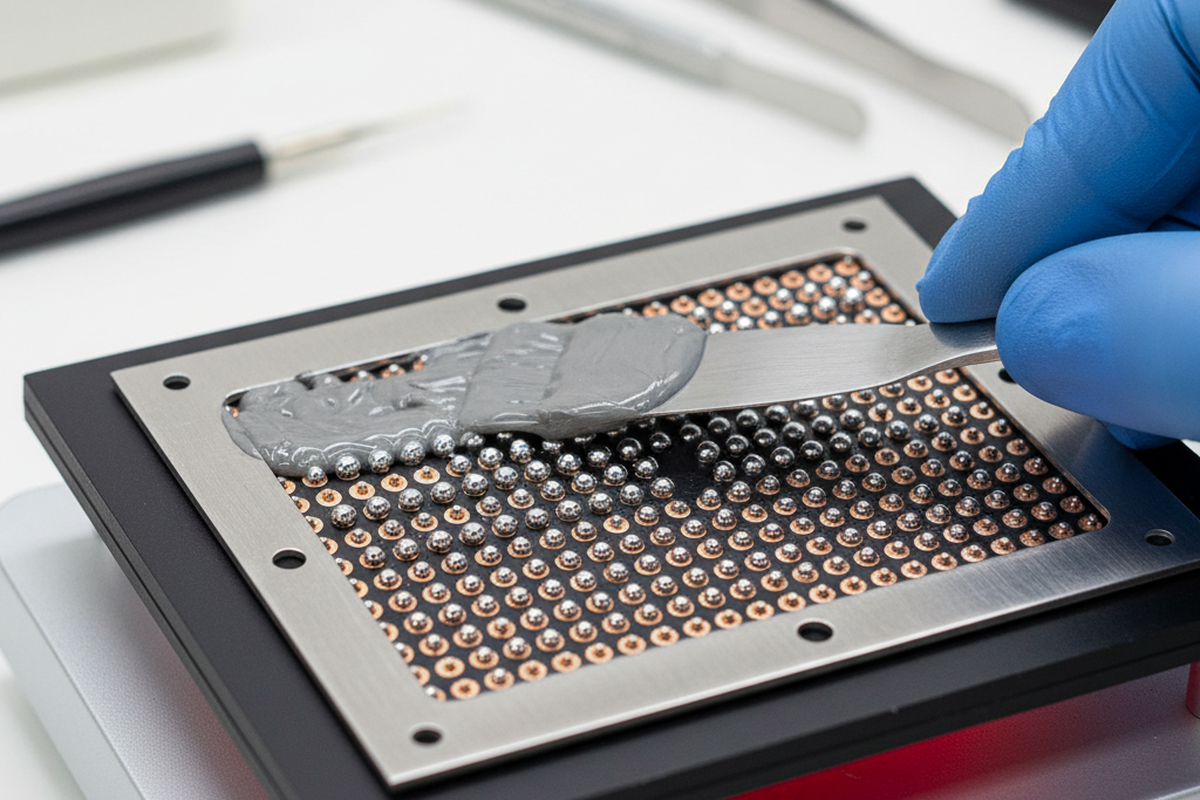
Une reball BGA ressemble souvent à une victoire claire : billes brillantes, pas de ponts, démarrage de la carte, tests fonctionnels rapides réussis, facture payée. C’est la version que les gens veulent.
Puis l’unité revient.
Fin 2017, dans un dépôt à Cedar Rapids, IA, un routeur à reballer a été expédié avec un étiquetage de voyageur portant RWK-17-0932. Il a passé tous les contrôles importants pour le débit. Six semaines plus tard, il est revenu sous ce qui allait devenir une étiquette de garantie récurrente, REB-RTN-30, montrant le même symptôme intermittent plus un nouveau. La découverte plus profonde n’était pas de mauvaises billes de soudure. C’était un problème de flexion de la carte près d’un point de montage et une érosion précoce des pads que le reballer n’a pas corrigé — et les cycles thermiques supplémentaires ont activement empiré la situation.
Ce retour expose le piège dans toute cette catégorie de travail : un reballer peut donner l’impression d’un succès tout en poussant une carte marginale vers l’irréparable.
Un atelier peut encore décider de reballer — Kline le fait certainement. Mais elle le traite comme une intervention mécanique contrôlée avec des portes, des artefacts et une limite de risque écrite, pas comme une réparation par défaut de qualité supérieure.
Conditions d’arrêt avant la chaleur
Arrêtez. Ne la chauffez pas encore.
Le triage prioritaire de Kline commence avant que toute station ne se réchauffe, car les échecs les plus coûteux dans le travail BGA sont ceux causés par des cycles thermiques inutiles. Sa visite NPI à Sioux Falls, SD (feuille de route R3) a produit un ensemble de contrôles peu attrayants : un plafond explicite pour le cycle de rework (réglé à 1 pour cette assemblée), une carte thermocouple (au centre + quatre coins + un connecteur en polymère à proximité), et une liste de contrôle par rayons X ajoutée au voyageur. Elle n’a pas ajouté ces éléments pour ralentir le rework. Elle les a ajoutés pour empêcher le rework de devenir la voie par défaut pour chaque défaut ambigu.
Une question courante en entrée est « doit-on reflow ou reballer ? » Cette question est déjà décalée d'une unité. Il existe une troisième option qui économise plus de cartes que l'une ou l'autre : ne pas toucher au BGA tant qu'il n'y a pas de preuve que le mécanisme est lié à une jointure. La revue KPI du dépôt de Kline en 2022 comprenait un rappel douloureux — environ 28% de cartes « pas de vidéo » arrivant avec des papiers de « reball demandé » qui finissaient par avoir des problèmes de VRM ou de MLCC en court-circuit. Les reballeries initiales ont gaspillé 1,5–2,0 heures de travail par unité et un historique de chaleur ajouté qui compliquait le diagnostic ultérieur. Un atelier ne peut pas se permettre de traiter « reballer vs reflow » comme un choix de menu lorsque la vraie décision est « toucher le package vs prouver le mode de défaillance ».
Il existe aussi des conditions d'arrêt strictes où un reballage n’est pas simplement « à haut risque » — c’est une dégradation prévisible. L’underfill en fait partie. À l’hiver 2020, Kline a inspecté des BGAs sous-remplis sous UV et a effectué une dépose contrôlée sur une carte sacrificielle. L’underfill s’est lié au masque et a tiré sur les pads lors du levage. Cette leçon s’est transformée en note de politique : UF-BGA : refuser sauf en cas d’analyse de défaillance uniquement. Cela faisait suite à une demande d’un courtier exigeant un SLA de 48 heures et traitant le travail comme un rebillage GPU routinier. La décision de Kline n’était pas philosophique ; elle a simplement reconnu que la carte serait ruinée avant que de nouvelles sphères ne la touchent.
La dernière étape est la discipline de la documentation. Dans son monde, « on a essayé » n’est pas un résultat de service ; un voyageur avec des critères d’acceptation l’est. Sans conditions d’arrêt écrites — présence d’underfill, déformation visible, nombre de reworks antérieurs inconnu, contamination impossible à éliminer — les décisions de rework dérivent vers celui qui est le plus confiant avec l’air chaud. Ce n’est que rarement celui qui a raison le plus souvent.
La santé des pads est le vrai critère de décision (Go/No-Go) — pas la compétence de retrait
Si un client dit « les pads ont l’air bien », Kline entend « les pads ont l’air bien à la magnification et à la concentration que nous avons utilisée ».
Sa journée de formation au printemps 2024 s’est concentrée entièrement sur ce biais. Deux techniciens juniors étaient sous un microscope avec un flux vidéo HDMI vers un moniteur, chargés d’écrire une décision go/no-go sur une fiche intitulée GO-NOGO-RWK v2Les cartes n’étaient pas dramatiques : un site propre, un avec une perturbation subtile du masque de soudure, un avec une érosion précoce ressemblant à « rien » à faible grossissement. La révélation inconfortable est venue plus tard — les vérifications de continuité enregistrées par net n’étaient pas en accord avec l’appel visuel confiant. Cette leçon resurgit lorsqu’une carte passe un test fonctionnel et devient toujours un retour : l’adhérence du pad et l’intégrité de la couche intérieure ne sont pas visibles simplement parce que le cuivre est encore « là ».
L’histoire du retour de 2017 cesse d’être une anecdote de précaution ici et devient une règle de décision. Une carte avec une défaillance due à une flexion près d’un point de fixation peut ressembler à une intermittence BGA parce que le stress se concentre aux coins — précisément là où l’érosion du pad apparaît en premier. Reballer peut temporairement changer le comportement du contact suffisamment pour le « réparer » à température ambiante pendant que la liaison pad-laminate sous-jacente se dégrade. Lorsque la carte retourne en service et subit à nouveau un cycle thermique et un stress mécanique, les nouvelles joints de soudure ne sont aussi bons que les pads sur lesquels ils reposent. Un rebillage « réussi » convertit effectivement une carte marginale en une défaillance latente.
Ainsi, l’ensemble de preuves minimum pour la santé des pads doit être plus que « l’air propre ». La porte de Kline est directe : si l’intégrité du pad ne peut pas être vérifiée, le travail est classé comme risque inconnu et par défaut conservateur. En pratique, cela signifie qu’au moins l’un des éléments suivants est requis avant qu’un rebillage ne soit considéré comme un travail de service responsable : inspection à haute magnification pour perturbation du masque et anomalies aux coins, vérifications de continuité/resistance qui sont enregistrées (et non simplement survolées), et un artefact corroborant tel qu’un contexte avant/après radiographie ou un changement de symptôme documenté sous stress contrôlé. Les outils exacts varient d’un atelier à l’autre, mais la décision doit être ancrée sur autre chose que de l’optimisme.
Kline rejette l'idée selon laquelle la reconfiguration des compétences consiste principalement à retirer la puce et à la remettre en place. La dextérité de retrait compte, bien sûr. Mais la décision de procéder est l'art qui détermine si la carte reste une réparation stabilisée ou une bombe à retardement.
Quand la reballing est réellement utile (mécanismes, pas mythes)
Kline n’est pas anti-reball. Elle est anti-reball aveugle.
La trace du mécanisme est le filtre. Si le symptôme est intermittent et corrèle avec la température ou la flexion mécanique, la fatigue des joints ou la tête dans l’oreiller est plausible. Si le symptôme est un court-circuit ou un effondrement de rail, les coupables à la probabilité la plus élevée dans ses journaux ne sont souvent pas le BGA — MLCC court-circuités, défauts du PMIC ou dommages au VRM que une reflow « guérit » temporairement en modifiant la résistance de contact. Elle travaille avec des probabilités, pas des certitudes. Les listes de symptômes sans preuve ne sont que du marketing.
Son cas de 2021 dans un laboratoire de radiographie tiers à Minneapolis, MN, est l’exemple le plus clair d’un reballing justifié par le mécanisme puis validé. Une carte a passé le test ICT et un test fonctionnel rapide après reball; la radiographie de face semblait acceptable pour un opérateur fatigué. Le technicien NDT a tourné à un angle oblique et la signature a changé — un motif de mouillage incomplet cohérent avec un risque de tête dans l’oreiller. Kline a suspendu l’expédition, révisé le profil (augmentation du trempage et ajustement de la montée en température), et la deuxième radiographie a montré une signature de mouillage matériellement différente. Le sujet de l’email du client a ensuite clarifié le point plus que toute conférence : Suspicion de HIP confirmée.
Cette séquence est importante car elle montre dans quelles conditions le reballing est la bonne décision : les preuves indiquent un mode de défaillance lié à un joint, et l’atelier a un moyen de vérifier le résultat au-delà de « ça démarre ».
La question « reflow ou reball ? » revient aussi ici. Encore une fois, la réponse utile n’est pas définitionnelle. Reflow sans diagnostiquer le mécanisme revient souvent à ajouter un cycle thermique non contrôlé. Reball sans vérifier l’état du pad revient souvent à ajouter un cycle thermique contrôlé. La troisième option — prouver le mécanisme avec des artefacts — détermine si l’un ou l’autre événement thermique est justifié.
Radiographie est une porte, pas une opération photo
L’expression « radiographié » est devenue un badge marketing. Kline la considère comme une porte avec des limites, pas un tampon.
Sa règle maison depuis 2019 est simple à décrire et ennuyeuse à faire respecter : aucune relocalisation de BGA sans comparaison documentée avant/après et un appel de vide, suivi en interne sous XR-GATE. Cette règle ne vient pas d’un comité de normalisation. Elle vient des retours et des litiges, et aurait réduit les retours sous 60 jours sur les unités reconditionnées d’environ 35% la première année de mise en œuvre. La raison pratique est évidente : une seule image post-rework peut sembler « correcte » sans prouver une amélioration, et une vue de face rate des motifs qui n’apparaissent qu’à un angle.
Nous devons corriger la confusion « radiographie comme case à cocher ». Un client demandant « ai-je besoin de radiographie après reball ? » essaie généralement d’acheter la certitude. La réponse de Kline est que la radiographie peut montrer la géométrie, les défauts grossiers et les motifs qui corrèlent avec le risque, mais elle ne peut pas prouver la métallurgie ou l’adhérence du pad. Elle est utile car elle est comparative et contextuelle : face de face plus oblique, avant versus après, et interprétée avec une limite d’acceptation écrite.
Les limites d'acceptation ne sont pas un pourcentage magique unique pour annuler. Kline refuse de donner un chiffre universel parce que ce n’est pas honnête. Le risque d’annulation dépend de la fonction de la boule (puissance/masse/thermique vs signal), de la géométrie et de l’espacement du package, et de l’horizon de fiabilité du client. Les voids regroupés de manière à suggérer un mouillage incomplet, ou concentrés sur des boules de puissance/masse qui transportent la chaleur et le courant, sont traités différemment des petits voids dispersés sur des signaux à faible contrainte. Dans ses écrits et formations, la règle est : si l’atelier ne peut pas expliquer pourquoi un motif donné est acceptable pour cette carte et ce cas d’utilisation, alors ce n’est pas un critère d’acceptation — c’est une ambiance.
Et il y a des cas où « la radiographie ne suffit pas » qu’il faut dire à voix haute. Si une crevasse sur pad est suspectée, des dommages à la couche intérieure sont plausibles (multicouche épais, cuivre lourd, profils agressifs antérieurs), ou si la carte est critique pour la sécurité, la radiographie seule est une faiblesse. Dans ces cas, Kline pousse vers une inspection plus approfondie (jusqu’à la microsection dans certains environnements) ou refuse la rework pour le déploiement en production. Cette position est impopulaire auprès des acheteurs qui veulent un test binaire unique. C’est aussi la façon dont un atelier évite d’expédier des cartes qui deviennent les suivantes. REB-RTN-30.
Profils thermiques : Respectez la pile ou acceptez les dommages
Un profil de rework universel est une faute professionnelle avec de bonnes intentions.
Kline ne répond pas à « quelle température pour un reball » avec des chiffres. Elle répond par la classification de la carte et les exigences de mesure. Épaisseur, densité de cuivre, blindages proches, dissipateurs de chaleur locaux, et la distance aux plastiques à risque collatéral sont les variables qui contrôlent les gradients et la déformation. Si celles-ci sont inconnues, le risque n’est pas « peut-être », c’est « plus élevé que ce que le devis suppose ».
Son incident de 2016 illustre le genre de dommage qui fait que ce point reste en mémoire. Sur une station de dépôt utilisant un chauffage IR supérieur avec un préchauffeur inférieur, elle a profilé pour le centre du BGA et ignoré un connecteur mezzanine en plastique situé à peu près 25 mm du bord du package. La carte est sortie en ayant l’air en bon état. Plus tard, le connecteur a été trouvé légèrement déformé, et la défaillance s’est manifestée comme un contact intermittent. L’autopsie a été consignée dans le dossier sous le nom de COLL-2016-04, et l’action corrective était ennuyeuse : construire une carte de thermocouples qui inclut des “spectateurs innocents”, et la garder avec les notes du profil. Même le choix de la méthode de fixation comptait en pratique (ruban Kapton versus époxy haute température), car des thermocouples qui mentent à l’opérateur représentent un autre type de danger.
Les mythes sur le débit peuvent faire du mal ici, en particulier la croyance que des températures plus élevées sont plus sûres parce qu’elles réduisent le temps de séjour. La réponse de Kline est que des profils plus rapides augmentent souvent les gradients, et ce sont ces gradients qui déforment les cartes, stressent les structures via-in-pad, et cuisent les connecteurs proches. Les étiquettes de sa bibliothèque de profils—Cuivre moyen 6L, Cuivre lourd 10L, Dense blindage RF—rappellent à l’opérateur que la classe de la carte est l’unité de planification, pas le package.
Un magasin qui souhaite être responsable sans publier de recettes OEM propriétaires peut toujours être précis. La liste de contrôle de profilage minimale qu’elle insiste est consciente de la pile : centre d’instrument et coins, instrument au moins un composant collatéral (souvent un connecteur), régler le préchauffage/immersion pour réduire les deltas avant de poursuivre le pic, et documenter les taux de montée et le delta maximum entre les points. Si un magasin ne peut pas mesurer ces bases, la réponse honnête n’est pas « nous serons prudents », c’est « nous ne pouvons pas prouver le contrôle ». Cela change si le travail doit être effectué ou non.
Règles de service écrites : une liste de contrôle pratique (et quand la rejeter)
À la fin du cadre de Kline, la partie « service » compte autant que la partie « retouche ». La sortie est plus qu’un simple support de démarrage — c’est une recommandation défendable pour le moment où l’unité échoue à nouveau sur le terrain.
Elle utilise un langage de mémo avec les décideurs pour cette raison. L’exemple de l’installation de grains 2023 est clair : une carte de contrôle de moteur industriel (épaisse, couche conforme, cuivre lourd) a échoué de manière intermittente, et le responsable de la maintenance voulait un reball BGA parce que « nous avons déjà réparé des cartes comme celle-ci ». Kline a redirigé vers des mathématiques opérationnelles : temps d’arrêt en $/heure, probabilité de succès, délai de remplacement, et coût de sécurité d’une défaillance latente dans une boucle de contrôle. Dans ce cas, le remplacement a surpassé la retouche et tout le monde était plus heureux parce que la décision a été prise dans les bonnes unités.
Une liste de contrôle pratique pour les services de retouche BGA ressemble à ceci lorsqu’elle est écrite pour éviter les arguments ultérieurs :
- Définir les conséquences: impact sur le temps de fonctionnement, responsabilité de garantie, exposition à la sécurité, et si la carte retourne à la production ou uniquement à l’analyse de défaillance.
- Arrêts durs (rebut/déclin sauf si FA uniquement): présence de sous-remplissage (
UF-BGA: classe de politique), déformation visible, cycles de retouche antérieurs inconnus ou excessifs, contamination impossible à éliminer, pads manquants/détériorés au-delà de ce qui peut être réparé avec une fiabilité acceptable, ou assemblages où la qualification et la validation ne sont pas disponibles. - Hypothèse de mécanisme: énoncer le mode de défaillance le plus probable (fatigue de joint, risque HIP, intermittence entraînée par flexion, dommage à la couche intérieure, défaut de rail non-BGA) et quelles preuves le falsifieraient.
- Artéfacts minimaux avant la libération: vérifications de résistance/continuité enregistrées sur les réseaux pertinents, carte thermocouple documentée et notes de profil, et comparaison par rayons X si applicable (
XR-GATE: pré/post, face frontale + oblique). - Critères d'acceptation: limites contextuelles (pas de pourcentage de vide unique), plus des déclarations explicites « ne peut pas prouver » (adhérence des pads, métallurgie, équivalence de durée de vie sur le terrain).
- Niveau de validation: vérifications minimales viables (exécution prolongée et tentative de reproduction des symptômes) versus vérifications plus strictes (dépistage de stress thermique, vérifications de flexion contrôlées) en fonction des conséquences de la défaillance.
Le problème « ça démarre » doit encore être dit clairement, car il continue de apparaître comme un point final. « Ça démarre » est une image instantanée. La fiabilité est une horizon temporel. Le retour du routeur 2017 rend évident le mode de défaillance : une carte peut réussir un test fonctionnel à température ambiante et échouer sous cycle thermique ou stress mécanique, surtout lorsque le mécanisme sous-jacent est la fissuration des pads ou la flexion. La règle de Kline est de réussir en équipe rouge : décrire la réussite plausible à court terme et l’échec plausible à long terme, puis décider si le cas d’utilisation du client tolère cette probabilité. La validation n’a pas besoin d’imiter la vie sur le terrain, mais elle doit être honnête sur ce qu’elle prouve et ce qu’elle ne prouve pas.
La question du coût — « le reball en vaut-il la peine ? » — est l’endroit où les ateliers deviennent accidentellement commerciaux ou évasifs. Kline évite ce piège en utilisant un cadre de coût attendu plutôt qu’un simple tableau de prix. Si la carte a peu de valeur, ou si le remplacement est disponible rapidement, et que le coût d’indisponibilité est modeste, une tentative de reball risquée est souvent irrationnelle même si elle est moins chère que le remplacement sur le papier. Si la carte a une grande valeur, que c’est la fin de vie (EOL), ou que l’organisation accepte explicitement une fiabilité réduite pour l’apprentissage (analyse de défaillance), un reball peut être rationnel — si les critères sont remplis et que le risque est approuvé. C’est la différence entre une recommandation de service et une histoire héroïque.
Les déclencheurs de rebut sont la partie inconfortable, et ils doivent être proches du sommet de tout document de règles de service car ils économisent le plus de temps et de cartes. Sous-remplir ce qui lie de manière agressive, une carte avec plusieurs cycles de chaleur antérieurs, une déformation visible ou une preuve que l’adhérence des pads est compromise ne sont pas des « travaux difficiles ». Ce sont des travaux qui payent une fois et coûtent deux fois lorsque le rappel arrive. Les propres reçus de Kline expliquent pourquoi elle est stricte : REB-RTN-30 existe parce que des décisions « envoyez-le » ont été prises sans vérification des pads et sans artefacts d’acceptation comparative.
Il y a aussi une déclaration de limite qui devrait apparaître dans toute rédaction compétente : la radiographie est utile, mais pas omnisciente. Le cas de l’oblique de Minneapolis démontre à la fois la valeur et la limite. Il a détecté un motif de risque d’humidification qu’une vue frontale aurait manqué, et il a justifié une révision du profil. Il n’a pas prouvé l’adhérence des pads, il n’a pas prouvé la métallurgie, et il n’a pas promis la durée de vie sur le terrain. C’est la maîtrise de la portée, pas du pessimisme.
FAQ (Court, parce que les Gates sont le point)
« Un atelier peut-il reballer sans radiographie ? »
Oui, mais cela devient une catégorie de service différente. Sans imagerie pré/post et angle-aware (interne XR-GATE style), l’atelier s’appuie davantage sur la discipline du processus et les preuves électriques, et les seuils d’acceptation devraient se resserrer. Pour les cartes à haute conséquence, « pas de radiographie » signifie souvent « refus ou FA uniquement ».
« Quel pourcentage de vide est acceptable ? » Un pourcentage unique est la mauvaise promesse. L'acceptation dépend de la fonction de la balle (puissance/masse/thermique versus signal), de la géométrie du package et de l'horizon de fiabilité du client. Un atelier devrait pouvoir indiquer le risque de localisation et de motif, pas seulement « l'air normal ».
« Pourquoi ne pas simplement reflow en premier ? » Parce que le reflow reste un cycle de chaleur qui peut déformer une carte, perturber le masque et pousser des pads marginaux vers la défaillance. Si le mécanisme n’est pas lié à une jointure, c’est un risque inutile. La troisième option — prouver le mécanisme — est généralement la solution la moins coûteuse.
« Comment un client peut-il savoir qu’on ne lui vend pas un reball ‘premium’ ? » Cherchez des artefacts : une liste écrite de conditions d’arrêt, un plafond pour le cycle de retouche, une carte de thermocouple et des notes de profil, ainsi que des images comparatives ou des mesures enregistrées. « Pas de réparation, pas de paiement » peut être un modèle commercial ; ce n’est pas une preuve de risque contrôlé.
« Quand ‘rebut maintenant’ est-il la meilleure recommandation technique ? » Lorsque le coût d’une défaillance latente est élevé (sécurité, garantie, dommages en aval), lorsque l’historique de la carte est inconnu mais probablement sévère, et lorsque l’intégrité des pads ne peut pas être vérifiée. Dans le cadre de Kline, ‘rebut’ n’est pas une insulte ; c’est une limite de décision contrôlée qui empêche des arrêts répétés et des pertes en cascade.
La ligne directrice la plus cohérente dans les règles de service de Kline est que refuser du travail est parfois la décision la plus responsable. Son passage en 2019 à écrire les critères de rebut dans le voyageur n’était pas une démarche conservatrice pour le plaisir ; c’était transformer « ce qui peut être fait » en « ce qui doit être fait », avec des reçus, des portes et des limites qui survivent à la prochaine dispute.
 French
  English
  German
  Arabic
  Spanish
  Portuguese (Portugal)
  Korean
  Indonesian
  Chinese
  Russian
  Italian
  Dutch
Dutch  Polish
  Hindi
Hindi  Thai
Thai  Portuguese (Brazil)