
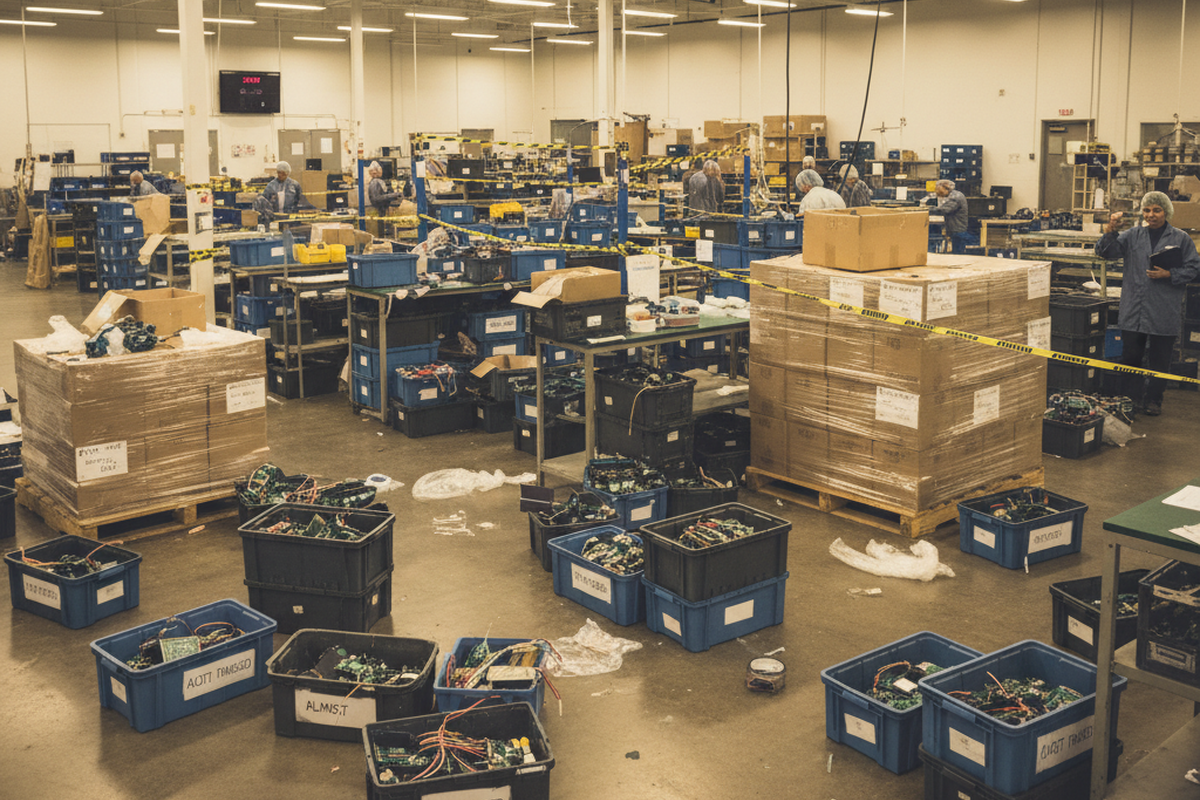
A staged build usually starts with a sentence that sounds harmless: build everything except the late part and hold it. Then the pallet shows up labeled “almost finished,” and nobody can answer what that means without opening boxes.
In Q3 2019, on a 240‑unit industrial controller run in Mesa, Arizona, “partial build” meant boards moved between areas as the floor got busy. Open-top ESD totes were shuffled, and the boundary between “AOI passed” and “pending touch-up” blurred until it vanished. When the late power IC finally arrived, the loudest idea on the floor was the same as always: just reflow them again. The build didn’t collapse because a part was late; it collapsed because the state of WIP became unknowable.
Staged builds don’t fail in the schedule. They fail in the physical truth of the factory. If a unit’s state can’t be answered in 10 seconds, it is already a defect in progress.
The Trap: “Mostly Done” WIP That Isn’t
A particular kind of chaos shows up only once boards are “mostly done.” It’s not dramatic; it’s quiet. A tote shows up at a bench. Someone needs space and moves it. A traveler packet is nearby but not attached. A label is missing because it curled in a dry cabinet, or because it was never applied where it could survive handling.
At that point, “Where do we store it?” is the wrong question. The real question is: what state is it in right now, and what transitions are allowed next? Post‑SMT but not AOI’d? AOI passed but repair pending? Awaiting late IC? Ready for selective solder or final test? If the only answer is a spreadsheet and a memory, the build is running on hope.
This is why “staging” turns into undocumented rework and silent escapes. In Mesa, the failure wasn’t a single mistake; it was the accumulation of little unowned transitions. Mixed stencil revisions. Boards with flux residue near a fine‑pitch connector because someone decided touch‑up could be “quick.” A suggestion to do a second full-board reflow because it feels like a reset button. Under time pressure, the factory did what it always does: it chose the path that lets work keep moving, even if the documentation couldn’t keep up.
Staging cannot operate as a scheduling hack. It is a manufacturing process with gates. If it can’t be written into a traveler with hold points and signoffs, it isn’t a plan—it’s a wish.
Define the Build You’re Actually Running
Treat staged builds as a state machine. This is boring on purpose. Name the discrete states, define allowed transitions, and attach physical artifacts to each state. “Post‑SMT/AOI passed” requires more than a vibe; it needs a bin label, a traveler stamp, and a storage rule. “Awaiting late IC” isn’t just a calendar reminder; it is a controlled hold point with authority and conditions.
A workable state list is specific rather than long. It includes a quarantine state for anything ambiguous, because ambiguity is the highest-risk state. If a board’s state is unknown, the allowed transition is not “ship it forward,” it’s quarantine plus re‑inspection—even if that feels slow. This rule isn’t moralistic. It is simply cheaper than discovering two weeks later that half the lot was touched by three different people with three different assumptions.
Hold points are the backbone. Post‑SMT AOI is a natural one. Pre‑selective solder and pre‑final test are others. While the exact list changes by product, the concept remains constant: there must be deliberate stops where someone verifies state and releases the next transition. If hold points aren’t real, the traveler is decoration.
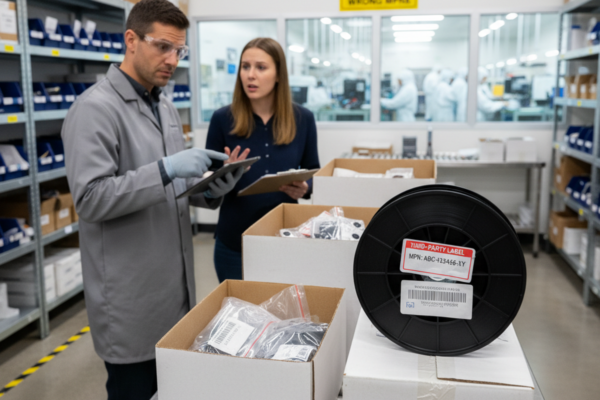
The adjacent pain that shows up here—especially in fast-moving teams—is that “double handling” often becomes “double kitting.” In Austin in 2022, a startup believed the CM was “losing parts.” The observed reality was messier: the completion kit was rebuilt from scratch, alternates were loosely controlled, and a connector with slightly different keying slipped through because the bag label didn’t make the difference obvious. Inspirational emails didn’t fix this. The solution required delta completion kits, photo callouts on the kit sheet, and treating approved alternates as an engineering-controlled list rather than a stockroom convenience. If the staged build has two material touches, it has two opportunities to re-decide the BOM unless the process removes that choice.
Ownership stops being an organizational slogan here and becomes a line on the traveler. Who signs the hold release? Who can say “no, this lot stays in quarantine”? If the answer is “everyone,” the real answer is “no one.” Staged builds only work when one accountable owner controls the rules end-to-end—either a CM manufacturing engineer with authority, or an internal manufacturing engineer who is actually present.
Spreadsheet staging is coordination theater. A traveler with hold points and physical controls is a process.
Thermal Budget: Why “Just Reflow It Again” Is Not a Plan
A second full-board reflow is not a neutral event. It is a decision to spend reliability margin.
The common rationalization is familiar: the datasheet says parts can handle multiple reflows, sometimes “up to 3.” That line is not a blanket permission slip. It assumes a specific profile, with a specific time above liquidus (TAL), ramp rate, peak, and dwell. Real ovens don’t run on assumptions; they run on the profile loaded today. A CM profile with 70–90 seconds TAL is a different exposure than a profile assuming 45–60 seconds, even if both are “within spec” on paper. The ledger is the exposure, not the slogan.
A thermal budget ledger starts with inventory: which components are sensitive to heat and mechanical strain? BGAs, QFNs, LGAs, plastic connectors, anything with warpage sensitivity, anything near heavy shields or stiffeners. Then it moves to measured reality: actual oven profile metrics, not the intended ones. Then it counts: how many excursions will this assembly see, including touch-up and rework that never makes it into the nice slide deck? It asks whether the late part can be installed with localized heat—selective solder, a controlled rework station with shielding, hot-bar—so the entire assembly isn’t dragged through another full cycle. Finally, it requires a residual risk statement and a proportionate monitoring plan: targeted x‑ray sampling or inspection where damage is likely, not a fantasy of testing away physics.
This matters even when functional test passes. In winter 2021, a sensor gateway build took a second full-board reflow to add a late RF IC. Units shipped. Then support tickets started clustering a few months later—intermittent loss of connectivity after 3–5 months, often in cold warehouse environments. The emotionally easy blame was firmware because “random” failures always feel like code. The hard work was serial-to-build-history correlation. The second reflow fingerprint clustered with the failures. X‑ray screening and cross-section work didn’t show a cartoonishly broken joint; it showed subtle damage near a shield can corner that had accumulated under thermal cycling and handling flex. The correction wasn’t dramatic: change staging so the RF IC could be added via a controlled rework profile instead of a full reflow, and tighten handling discipline so the assembly didn’t get mechanically stressed between thermal hits.
The decision rule is unglamorous: do not stage in a way that forces a second full-board reflow on a sensitive assembly unless the team can document the real profile, count total excursions (including rework), and accept the residual risk with eyes open. If none of that information exists, the “fast” option is just borrowing failure from the future.
MSL and Time Gaps: Make Floor Life Physical or Pay Later
Staged builds create time gaps, and time gaps create invisible accumulation. Moisture exposure is one of the dumbest preventable failure modes in electronics manufacturing because it is not a design mystery. It is a process control choice.
The common pattern is paperwork compliance masking physical noncompliance. A humidity log exists, a procedure exists, yet reels still sit on a cart by the line because walking to the dry cabinet feels like wasted time. In Tijuana in 2020–2021, the mismatch between “MSL compliant” language and actual behavior wasn’t subtle once someone watched the floor. The corrective action that worked wasn’t more training. It was making exposure visible: time-out tags with date/time out and operator ID, and a gate that forces a decision when the tag hits the limit. If it’s over, it goes to bake or it gets scrapped per the supplier’s MSL guidance. The politics were real because the rules made someone’s job harder in the short term. The payoff was also real: fewer moisture-related NCRs and shorter, less frequent MRB meetings.
Teams often get distracted by the wrong question. They ask, “What’s the correct bake schedule?” as if the schedule is the core fix. Bake guidance is supplier- and package-specific, and it’s irresponsible to prescribe universal temperatures and times in a generic field guide. The controllable part in staged builds is exposure tracking and a documented decision gate in the traveler: tag when it comes out, store at controlled RH (targets like ≤5% RH are common), and define who decides bake vs scrap vs proceed. That is how floor life stops being a debate and becomes an operational truth.
If the exposure history is unknown, treat it as over-limit until proven otherwise.
Storage Is a Process Step
Factories often treat storage like it’s inert: a shelf, a tote, a corner. In staged builds, storage is a process step, and it has failure modes.
ESD is the obvious one, but the quiet failures are usually mechanical and cleanliness-related. Open-top ESD totes invite stacking and incidental contact. Foam inserts can shed crumbs that end up on test pads and turn into intermittent ICT contact problems. Boards stacked without spacers chip 0603 ceramics on edges, and AOI may not flag it in a way that matches how that chip fails later in HALT or vibration. Labels applied too early curl or fall off in low humidity storage, and suddenly the serial-to-history truth you thought you had is gone. Each one of those is a small, preventable yield hit that turns into a big MRB cycle when it spreads across a lot.
A tempting “protection” move that deserves a specific warning is early conformal coat to “protect WIP.” In Phoenix in 2018, a team under outdoor deployment spec pressure wanted to coat partially built boards during a long wait for a connector. The result was predictable: coating locked in whatever contamination existed and made later soldering harder. When the connector arrived, selective solder struggled with wetting and left residues, and rework became slow and damaging. The staged build got “protected” in a way that created downstream failure modes. The better pattern is boring: packaging, covered conductive bins, controlled humidity, and mechanical protection. Environmental protection (coat/potting) is not the same as storage protection; mixing them creates rework traps.
This is the traveler-shaped version of storage: specify packaging and location as a step, not a suggestion. Define what bin type is used (covered conductive bins, not open totes), what cleanliness rules apply (caps on sensitive features if needed), and what label must be present and durable before WIP moves. If it’s not specified, it will not be consistent across shifts, and night shift is not obligated to guess.
Materials and Kitting: Staging Multiplies Decisions
Staging doesn’t just add handling; it adds decision points. Each decision point under time pressure becomes an opportunity for “almost right” to ship.
The Austin 2022 connector keying mismatch is a clean example. The materials tech wasn’t reckless; the system made the wrong choice easy. The completion kit was treated like a separate build, alternates were loose, and labels didn’t highlight the difference that mattered. Once the process changed—delta completion kit instead of a full rebuild, photo callouts on the kit sheet, and alternates tightened as an engineering-controlled list—the surprises stopped. The point is not to blame materials. The point is that staged builds amplify weaknesses in the materials system because they multiply touches.
Two rules make a measurable difference without turning into a full bureaucracy. One: completion kits should be controlled deltas, not full rebuilds, and that delta should be tied to specific WIP states (“awaiting late connector,” “ready for completion”). Two: approved alternates must be treated as engineering decisions with explicit qualification status, not as a stockroom decision made to keep a line moving.
What to Do Monday Morning
A staged build that survives reality starts with artifacts, not optimism. The minimum spine looks like this: define the discrete WIP states and print them into the traveler as steps and holds; define physical storage per state (covered conductive bins, controlled RH storage like a dry cabinet where needed, mechanical protection); define labeling that survives the storage environment; and define a quarantine state with a no-argument rule when state is unknown. Put a daily WIP walk on the calendar with the process owner and the line lead, and make disposition visible through MRB/NCR logs so “mystery boards” show up as a metric, not a rumor. If traceability matters to the customer or the audit, tie staging labels to the traveler record—QR-linked status labels are one pragmatic way to reduce transcription errors—then enforce the rule that unlabeled WIP does not move.
Then attach authority to it. Someone signs hold releases. Someone owns the thermal budget ledger when late parts threaten a second reflow. Someone owns MSL exposure gates and the bake/scrap decision path. If the plan depends on “PM coordination,” it will degrade the moment the floor gets crowded.
There is a mainstream position that says “just wait for all parts; staging is always riskier.” It’s incomplete. Waiting can be the correct decision when the only staging path requires a second full-board reflow on a sensitive assembly and the team cannot document profile metrics, excursion counts, or MSL exposure history. Waiting is also correct when the organization cannot enforce traveler discipline, labeling durability, and quarantine rules—because staging without those controls is not controlled staging, it’s deferred ambiguity.
The correct comparison isn’t “staging vs waiting” as an abstract moral choice. It is “which option minimizes the worst credible business damage given the controls that actually exist.” If the controls are weak, waiting may be less damaging than shipping latent failures. If the controls are strong, staged builds can protect commitments without turning into a weekend containment event.
The final test is intentionally rude: can someone on night shift walk up to a unit and tell its exact state in 10 seconds—post‑AOI, pending touch-up, awaiting late IC, MSL clock running, ready for completion—based on the label, the bin, and the traveler hold status? If not, the staged build is running on ambiguity, and ambiguity is how “mostly done” becomes “mostly untraceable.”




 English
  German
  Arabic
  French
  Spanish
  Portuguese (Portugal)
  Korean
  Indonesian
  Chinese
  Russian
  Italian
  Dutch
Dutch  Polish
  Hindi
Hindi  Thai
Thai  Portuguese (Brazil)