

Late in 2019, an EMS plant outside the Elgin area thought it was running a polite recall drill. Then the supplier email updated from “suspect” to “confirmed,” and a customer quality engineer demanded a list of shipped serials within the hour. The plant could export a CSV from the MES. Board serials and timestamps were there. The lot fields were mostly blank.
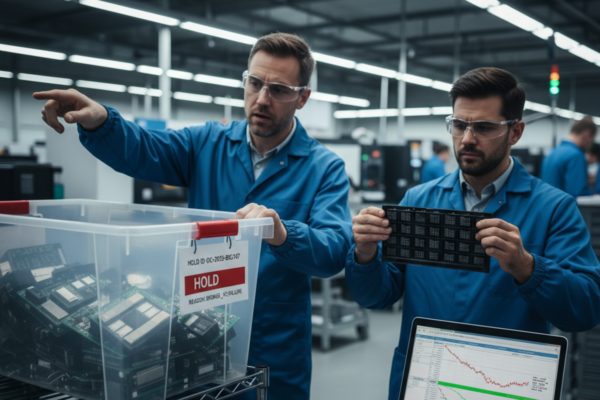
The operational moment wasn’t about “traceability” as a concept. It was a containment decision under a clock: which units get quarantined, right now, and how defensible is that answer at 4:45 PM on a Friday.
That’s the frame that matters for serialization and traceability on an SMT line. It isn’t about dashboards, software modules, or processes that look clean until the first real exception hits.
The Only Definition That Holds Up: The Containment Question
If a traceability program cannot answer a supplier-lot question fast and honestly, it fails in a predictable way: the quarantine scope expands until uncertainty is “managed” with brute force. In the Elgin-area event, the containment answer became “three weeks of finished goods”—not because three weeks were impacted, but because the system couldn’t narrow the scope without guesswork.
A common protest in plants is, “The data exists.” It often does—somewhere. Receiving scanned reel barcodes into inventory; production captured work orders; the line had serial numbers. But the chain between receiving reel IDs and unit build records didn’t exist in a way that survived pressure. Storage is not truth. Links are truth, and links are what recall-grade traceability buys.
This guide ignores vendor feature lists on purpose. It focuses on the mechanics and governance that decide whether data capture can happen at line speed without becoming the scapegoat for every throughput miss.
Recall-Grade vs. Dashboard Traceability
The fastest way to explain “recall-grade” traceability is to walk it backwards, because that’s how incidents arrive.
Start at shipment: customer, ship date, carton/pallet identifiers. Step back to finished unit serials. Step back to work order and process steps (placement, reflow, SPI/AOI checkpoints if meaningful). Step back again to material consumption: which reels, which lots, which substitutions, and which rework transactions touched those serials. End at receiving: supplier lot, internal lot, reel ID, and whatever translation was needed to make a barcode actually mean something.
That backwards walk is what procurement and quality try to do during containment, whether the plant admits it or not. One Ontario EMS site stopped treating genealogy as an engineer-only artifact once a single report existed: input supplier name + lot + internal part number; output finished serials, work orders, ship dates, and customers. Delivered as a saved query with a scheduled email to a buyer’s shared mailbox, it turned an “engineering problem” into a 15-minute procurement action.
The uncomfortable part is that many programs are partial and pretend not to be. There is nothing inherently wrong with minimum viable traceability in a low-risk context—but it must be labeled as such. If a genealogy report produces “MFG LOT: UNKNOWN” for a high-risk capacitor class, that isn’t a minor defect; it is a false confidence generator.
Audit requirements usually surface here. “Do we need full traceability for audits?” Requirements vary by customer and industry, and nobody should pretend otherwise. The practical rule is simpler than the regulatory debate: define what decisions the plant needs to make under pressure, then confirm the links needed to support those decisions are actually captured. Treat anything beyond that as phased scope, and watermark reports when data completeness is not guaranteed.
Plants often pivot immediately to hardware: “Which scanner should we buy?” They ask because they’ve been told to “make scanning faster.” But speed rarely comes from a model number. It comes from semantics and placement: Code 128 versus DataMatrix fields, consistent delimiters, parsing rules that don’t drop leading zeros, and a workflow that doesn’t ask the constraint station to do extra motions. Hardware matters only after the label standards and capture points stop forcing people to interpret barcodes with their eyes.
How to Capture Without Stealing Seconds
Draw one line early, because it explains most “traceability slows us down” stories:
The constraint does not care about intent.
In Spring 2022, a mid-volume consumer electronics line in the GTA ran a constraint product at roughly 7–9 seconds per board. A post-reflow station asked an operator to scan the board serial and then scan component lot labels from a cart. On paper, it was a 12-second task that could be “smoothed.” On the floor, it turned steady flow into pulsing flow: scan, batch, catch up, skip. The bypasses were not malicious. They were survival choices, made in the open-air space between an approaching queue and a hot order.
The most common mistake is placing lot capture where there is no natural slack. Post-reflow feels attractive because it is “downstream” and seems less invasive. But downstream stations often see boards arriving every few seconds, exactly where extra actions create a new bottleneck. An added 6–9 seconds per board at the wrong point is not “a few seconds.” It is a new constraint, and it will be fought.
The “scan at the end” idea deserves a hard red-team. It is mainstream because it avoids changing receiving, kitting, and feeder load behavior. It fails because it concentrates risk and motion at the point where the line has the least patience. It invites batching (which ruins one-to-one association timing) and skipping (which ruins data integrity).
The rebuild is almost always upstream association: bind the unit serial to a controlled material set earlier in flow. In the GTA case, the program stopped trying to scan individual lot labels at post-reflow. Instead, kitting created a tote/kit ID representing the component lot set, and at load the operator did one scan to bind board serial to kit ID. Same data, different capture point. Complaints about “traceability killing throughput” disappeared because the program stopped stealing actions from the constraint and made data capture ride along with work that already had to happen.
From a chain perspective, the minimum viable association looks like this:
Receiving must create a stable identity for each reel/lot that survives damage and relabel events. Kitting must associate the reel identities to the kit/tote identity for a work order (or a defined batch). The line must perform a single, non-optional bind between unit serial(s) and the kit/tote ID at a point with control—often feeder load verification, load-in, or a controlled handoff. Downstream process steps can then inherit the material genealogy without repeated scans that add seconds per board.
There is no magic in that structure. It simply reduces scan count while increasing confidence, performing the association where materials are being controlled rather than where chaos is being managed.
None of this means scanning latency is imaginary. It shows up in the ugly details: glove use, glare off laminated labels, cart clutter, and confirmation delays that turn a “quick scan” into a stall. One observed bottleneck pattern was a rugged scanner like a Zebra DS3678 paired with Wi‑Fi roaming delays; 2–3 seconds of transaction lag at peak becomes visible stops. Switching to Ethernet at the station and adding local buffering eliminated the pauses because the operator’s motion was no longer gated by network timing.
These aren’t “IT problems” or “operator problems.” They are design inputs. The line-speed reality check is to map every interaction—grab, orient, scan, confirm, place—including failure paths, then time it on the floor (or via video) on the constraint SKU. Cycle-time impact varies by mix, layout, and skill, which is exactly why a program should treat stopwatch data as a requirement, not a nice-to-have.
Exception Handling Is the Traceability System
A plant can have clean normal flow and still have unreliable traceability because the chain breaks in the edges: damaged labels, split reels, substitutions, rework, scrap, and “just keep it moving” decisions that aren’t logged. These aren’t rare; they are daily.
The “TEMP-REEL” epidemic is a predictable outcome when a system requires a barcode to proceed and the real world refuses to provide one. In a Grand Rapids-area manufacturer serving regulated customers, unreadable supplier labels (smeared ink, curled labels, humidity peeling off Sharpie workarounds) drove receiving into a shortcut: create a “TEMP-REEL” ID and scribble a note. The dock didn’t backlog, so the workaround felt productive. Within a quarter, genealogy dead-ended across dozens of reels because nobody could prove which “TEMP-REEL” was which. Audit prep turned into archaeology. The fix was not better software; it was a controlled relabel workflow with witness sign-off, a quarantine bin with red tags for unreadable labels, and an exception log reviewed every week.
The “we’ll handle exceptions manually during a recall” mindset is a risk statement, not a plan. Manual reconstruction is possible in theory, but it burns the best people for days while production stalls and procurement acts with uncertainty. Exceptions also scale in clusters: shift change, supplier label changes, high-volume weeks, and hot builds are exactly when exception volume spikes.
Rework is the back door that most traceability programs forget until a customer asks the most pointed question in the building: was the failing part original, or replaced? In early 2023, an automotive-adjacent site captured reel lots on the main SMT flow, but the rework bench ran on bench stock drawers labeled by internal part number, not supplier lot. A customer wanted an 8D-style containment narrative and asked whether rework touched specific serials. The system could not prove it, and the most experienced rework tech felt accused by the absence of evidence. The corrective action was minimal but decisive: scan unit serial, scan replacement part lot (or a controlled “bench stock” lot), and record a reason code list trimmed from 27 options down to 8 that people would actually use. After initial resistance, the data became protective—evidence that the bench did what it claimed, and a way to separate upstream defects from rework actions.
Substitutions are the other chain-break that shows up as “throughput pragmatism.” A Midwest contract manufacturer running high-mix prototypes into low-volume production had a feeder go down; a material handler grabbed a “close enough” reel from another job to keep the line moving. The BOM in the system still showed the original part number, and feeder load had no enforced verification scan. Weeks later, failure analysis pointed to the substituted component family, and nobody could isolate which units received it. That is how containment scope expands: the plant ends up treating “a few boards” as “maybe everything.”
Exception-first design isn’t pessimism. It is a declaration of what the system is actually for: defensible decisions when reality refuses to behave.
Reporting That Procurement and Quality Can Actually Use
Traceability is not complete when the data is captured. It is complete when the people who carry the pager can answer their questions without an engineer translating screen dumps.
A practical report-consumer test is blunt: pick three questions procurement and quality ask during incidents, then watch them try to answer using current tools. Common questions are boring and urgent: which finished serials contain supplier X lot Y; which customers received them and when; and what work orders and substitutions were involved. If the only way to answer is “open each serial one at a time” or “export and pivot,” the program is postponed, not done.
The “the data is there” excuse should die here. A genealogy report that can generate “UNKNOWN” lots without flagging incompleteness isn’t neutral; it misleads. Reports should carry a data completeness indicator that prevents over-trust, including obvious watermarks like “INCOMPLETE DATA: LOT CAPTURE NOT ENABLED” when a product line or part class is outside scope.
A Service-Layer Rollout That Survives Second Shift
Treating traceability as a software purchase is how plants end up with theater: modules installed, labels printed, and a bypass culture that quietly forms during hot builds and at 2 AM when the admin is asleep.
A service-layer framing is less glamorous but more accurate. The “product” is workflow + tooling + governance + reporting. That includes ownership (who fixes scan failures), defined exception paths (what happens when a reel barcode is damaged), and basic SLAs such as scan uptime expectations, relabel resolution time, and a cadence for reviewing exceptions. One practical governance artifact that has worked is simple: a one-page “Scan Rules & Exceptions” sheet laminated at each station, plus a weekly 20-minute exception review with production and quality where relabel counts, bypass rates, and “unknown” entries are treated as operational defects.
Rollouts that stick tend to look phased rather than heroic. Pilot one line. Stabilize capture points and exceptions. Validate reports with procurement/quality. Then scale using templates: the same receiving relabel rules, the same kit association transaction, the same rework transaction, and the same completeness watermarking. The metrics that matter early are not “percent scanned” in a slide deck; they are bypass rate, exception rate, relabel count, and time-to-containment for a test scenario.
Vendor pitches often claim automation solves human error. Automation can help, but it often relocates failure modes—misreads, misparses, lighting sensitivity, and unhandled exceptions—unless the service layer exists. The bad-day question remains the same: what happens on second shift when a label smears, Wi‑Fi hiccups, a new hire is on receiving, and production is already behind?
End with a 15-minute operational checkpoint that forces honesty. Pick one supplier lot (real or simulated). Run the containment query that matters: list impacted finished serials, work orders, ship dates, and customers, and identify whether any units are untraceable due to “UNKNOWN” or missing links. If it cannot be done in 15 minutes without an engineer translating, the program is not recall-grade yet. If the report returns results without marking incompleteness, it is not safe to trust under pressure. And if the capture process steals seconds from the constraint station, it will be bypassed and blamed until it is redesigned to ride along with the work.
That is the practical definition of traceability that doesn’t slow an SMT line: fewer actions at the wrong station, more controlled associations upstream, and a system that treats exceptions and report consumers as first-class citizens.




 English
  German
  Arabic
  French
  Spanish
  Portuguese (Portugal)
  Korean
  Indonesian
  Chinese
  Russian
  Italian
  Dutch
Dutch  Polish
  Hindi
Hindi  Thai
Thai  Portuguese (Brazil)