

A broker lot can arrive looking clean, priced like a miracle, and timed like an answer to prayer. That is exactly when it gets dangerous.
In one documented case from an EMS environment shipping industrial controllers, a microcontroller lot with unusually crisp markings and tidy trays was released under schedule pressure. Then in-circuit test yield drifted from about 98.7% down to 91% in a pattern that didn’t map to solder defects. The lot was pulled into quarantine mid-run under an internal hold ID (format QH-18-073), and an external decap was expedited to 48 hours for about $1,250. The die revision didn’t match the claimed ordering code. Visual checks hadn’t failed; the decision system had.
That gap—between “looks fine” and “is defensible”—is where broker buy containment lives. This isn’t a morality play about brokers. It’s a workflow for making sure uncertainty gets smaller before the lot touches production, and for keeping the downside bounded when the organization insists on speed.
Risk, as a Number You Can Use Under Pressure
Most teams argue about broker material as if the choice is binary: ship on time or be “the quality person” who blocks revenue. The version that survives reality is different. The real trade is bounded loss versus unbounded loss.
A common executive prompt in expedite meetings is: there’s a ship date with a penalty clause in the customer SOW, so can the material be “quick-checked” and released? In at least one such case, leadership was looking at a broker quote around $34.80/unit against a historic $6.10. The desire to treat “factory sealed trays” as a sufficient answer was strong. The containment framing that works is blunt: if provenance is murky, the only rational responses are (a) tighten the gate, or (b) cap the blast radius with staged release while parallel-pathing verification. Treating schedule as a reason to lower controls is how a penalty becomes a recall.
There is also a quieter version of the same argument that shows up in cost reviews: inspection spend looks like waste. In one internal review, a low-value passive around $0.18 sourced through a dubious channel triggered rework that consumed roughly 48 technician-hours and delayed shipment four days, with expedited freight adding roughly $1,900. In a different lot, $600 spent on targeted analysis prevented an entire build from being contaminated. Those numbers aren’t universal statistics; they are receipts. They show why the decision should be modeled as expected loss: probability of nonconformance times cost of escape, plus the probability of false reject times receiving delay cost. The point isn’t the spreadsheet. The point is that a consistent model stops arguments from becoming theater.
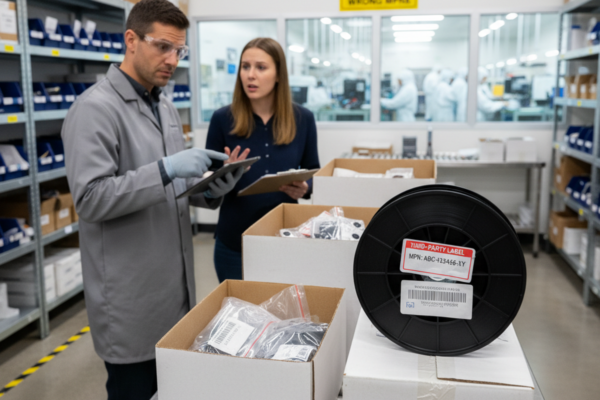
If the broker is “reputable,” ISO-certified, or supplies a certificate of conformance, that’s not meaningless—but it’s not provenance. The only thing that changes the risk tier is chain-of-custody evidence that can be checked: original PO linkage to an authorized source, traceable lot/date code that reconciles with manufacturer records, and sealed original packaging with intact labels. Without that, the controls don’t loosen. They tighten.
Non-authorized material does not bypass quarantine. Ever.
A workable way to force consistency is to stop asking “is this safe?” and start asking “what is the worst credible outcome if this lot is wrong, and what controls cap that outcome fastest?” Then tier the lot and choose controls that reduce expected loss per day, not controls that produce comfort.
Quarantine Is a System (Not a Receiving Hold)
The cheapest high-leverage control in broker buy containment is physical. If a lot can drift into kitting, every later debate about authenticity is already late.
In one audit moment that shaped how containment is designed, a customer auditor working under ISO 9001 expectations asked a simple question: show evidence that a suspect lot never entered production. The team that passed didn’t win by arguing intent. They walked the auditor to a locked wire mesh quarantine cage with numbered shelves, showed yellow hold tags with barcodes, and pulled ERP transactions showing the material status in HOLD-QUAL (and HOLD-ENG). They produced pick logs and a sign-out sheet showing controlled access. The auditor didn’t have to trust them; they had to accept the evidence.
That is the definition of quarantine as a system: rules, controlled storage, system status, and retrievable artifacts. An ERP hold by itself isn’t a system; people work around screens. A cage by itself isn’t a system; cages get full and shortcuts appear. The minimum is both.
Small teams push back here because they don’t have a formal QMS, or because receiving is one person with a label printer and a spreadsheet. The answer isn’t “be like a medical OEM.” The answer is to design for the same failure modes with lighter tools. In a cross-border environment where a gray lot arrived with only a packing list and forwarded emails, the failure wasn’t the absence of a formal CoC template. The failure was commingling risk: parts sat on open shelving near approved inventory because the cage was full and nobody wanted a line stop. A minimal viable fix was consistent labeling that survived bilingual handoffs (English/Spanish), a segregation map tied to shelf locations when ERP location control was unreliable, and a hold log that could answer, under pressure, where the lot went.
We assume you already know the basic PCBA flow. The work here starts where the arguments start: what happens when questionable material is on the dock and the schedule is already late.
Tier the Lot, Then Pick a Sampling Plan You Can Defend
Containment collapses when every broker lot is handled the same way. The workable pattern is a small number of tiers with explicit triggers, tied to explicit actions.
A practical three-tier model that shows up in real EMS containment looks like this:
| Tier | What makes it this tier | What happens next (minimum) |
|---|---|---|
| Green (elevated-but-manageable) | Verifiable chain-of-custody to an authorized source; original packaging intact; labels consistent; part is not high-criticality | Quarantine + documented screen; controlled release with sign-off; records stored under hold ID |
| Yellow (uncertain) | Missing artifacts; inconsistencies in labels/packaging; new broker; moderate criticality; market reality smells off | Quarantine + tighter sampling + predefined escalation triggers; staged release preferred |
| Red (high-risk) | Murky provenance plus high criticality; out-of-family packaging; cannot reconcile lot/date code; refusal to provide basic evidence | Quarantine + authenticate (or do not use); restricted pilot only if OEM accepts residual risk in writing |
The “smell-test” triggers that keep this from turning into vibe-checking are concrete and fast to apply. If a seller claims “factory sealed” but cannot provide even a photo set of moisture barrier indicators for an MSL part, that matters. If a CoC exists but there is no original PO linkage and no lot trace beyond a packing list, that matters. If price and availability are too-good-to-be-true compared to known lead times, that matters. If the part family is known to be frequently remarked or resurfaced, or if it is hard-to-rework once placed (fine-pitch QFNs, BGAs), that matters. And if the broker refuses basic artifacts—packaging photos, lot/date code reconciliation, chain-of-custody story beyond “excess”—that matters more than anything they say in a call.
Sampling is where many teams want a single number. “How many parts should receiving pull?” is asked as if the answer can be divorced from fraud mode and stakes. It can’t.
In one metal-bodied component lot around 3,000 pieces, a handheld XRF unit shared as a metrology resource was booked in 30-minute slots, and a defined screen sample of 20 pieces was run. The alloy family came back out of expectation—not subtle drift—and the lot was rejected while explicitly documenting that XRF is a screen with limitations. That sampling decision made sense because the suspected risk was material substitution that XRF can meaningfully reduce, and because the product had outdoor exposure requirements where engineering referenced ASTM B117 salt-fog context. The sampling number wasn’t magic; it was part of a plan: screen enough to justify stopping, escalating, or proceeding.
Sampling intended to “prove authenticity” is quality theater. Sampling intended to create triggers—if any anomaly appears, escalation occurs; if no anomalies appear, a restricted release may proceed—is a lever that can cap expected loss. And it must be paired with escalation rules, otherwise a clean sample becomes a false certificate.
Stop Doing Quality Theater: Use a Trigger-Based Escalation Matrix
The most common containment failure isn’t that teams skip visual inspection. It’s that they stop there and then behave as if they did something decisive.
A second, equally common failure is the belief that functional test, ICT, or burn-in will “catch it.” Coverage doesn’t equal provenance. It is possible for a wrong die to pass functional test at room temperature and fail in the field. It is possible for prior moisture exposure to survive incoming inspection and show up as cracks in reflow. It is possible for die-level substitutions to produce intermittent resets that do not reproduce on a bench. In at least one RMA episode, 17 units came back in a quarter with intermittent symptoms, and the customer reliability engineer’s stance was direct: without defensible containment, the assumption becomes that inputs are uncontrolled. The internal corrective action that changed future decisions wasn’t “inspect harder.” It was formal escalation triggers by part family and criticality, and a willingness to scrap remaining inventory even when margins hurt.
The containment stance here is opinionated and practical: visual inspection is necessary, but by itself it is mostly performative once provenance is weak. A good system maps plausible fraud and failure modes to the cheapest test that meaningfully reduces uncertainty, and then makes escalation automatic when triggers are hit.
A workable escalation ladder looks like this:
Screen → Verify → Authenticate (with artifacts at each step)
Screen (fast, cheap, designed to stop obvious lies)
- What it targets: gross mismatches, packaging anomalies, obvious remarking clues, dimensional outliers, solderability indicators, and basic documentation gaps.
- Typical actions: photo set of labels and packaging under the hold ID, quick dimensional/weight checks, comparison to known-good samples if available, and a documented documentation review (what exists and what doesn’t).
- Artifacts that must exist: hold tag ID, packaging photos, label photos, PO and receiving record, initial risk tier.
Verify (targeted tests tied to likely modes)
- What it targets: specific mismatches that screens can’t resolve.
- Typical actions by commodity:
- XRF alloy screening for metal-bodied parts when material substitution is a credible risk (document spectra summaries under the hold ID).
- X-ray for internal leadframe/package anomalies inconsistent with the claimed family (document images and interpretation limits).
- Solderability indicators or bake/handling checks when moisture sensitivity (JEDEC concepts) is a credible risk.
- Artifacts that must exist: test summaries tied to the hold ID, sample size and selection method, pass/fail criteria, and trigger outcomes.
Authenticate (slow, expensive, used when identity matters)
- What it targets: die-level authenticity and identity swaps that cannot be resolved by external features.
- Typical actions: decap or CSAM at an external lab with method description, especially for high-criticality ICs where the cost of escape dwarfs the cost of confirmation.
- Artifacts that must exist: lab report PDF, method notes (what it can and cannot conclude), chain-of-custody record for the samples sent, release decision sign-off.
A recurring adjacent demand signal in expedite environments is: “Can the team just X-ray it and move on?” X-ray is useful, but it isn’t a universal stamp. It can show internal construction inconsistencies, voids, leadframe oddities, and in some cases anomalies that strongly suggest a mismatch. It cannot, by itself, prove the die matches the ordering code. That’s not pessimism; it’s scope control. Tests reduce specific uncertainties. They do not create truth in general.
This is also where a system either survives or turns into arguments: release authority must be explicit. Many teams implement a two-person rule for releasing broker material—buyer plus quality sign-off—with an escalation matrix that defines when engineering must be involved (HOLD-ENG) and when external lab authentication is non-optional. If the system depends on a hero’s gut feeling, it will fail the first time that hero is on a plane and the SMT line is starving.
Two more practical notes belong here because they keep teams honest. First: lab costs and turnaround vary. A decap might be quoted at five business days one month and be expeditable to 48 hours the next, and the price for that acceleration can be the difference between a planned decision and a panic decision. Second: XRF isn’t a lie detector. Geometry, plating thickness, and finish can distort readings; it is best treated as a screen for certain material substitutions, not a final authenticity verdict. A matrix makes those limits explicit so a “pass” is not misused as a guarantee.
When You Can’t Say No: Design a Smaller Failure (Staged Release)
Sometimes the organization won’t accept “do not use.” Sometimes the ship date is contractual. Sometimes redesign is the only true fix but it won’t happen in time. In those cases, the only responsible option is to design a smaller failure.
In one expedite meeting shaped by a penalty clause, the choice was framed as: release the “sealed trays” now or miss the date. The containment alternative that kept the downside bounded was staged release: a pilot build of about 150 boards, enhanced inspection gates, and a parallel engineering change request opened as a contingency path if the lot didn’t authenticate. That choice wasn’t slow for the sake of being slow. It was a strategy to avoid contaminating a full build with uncertain material.
Staged release works when it’s treated as a workflow, not as a loophole. Typical controls that belong in a staged release include: restricting the material to a defined build quantity; tightening post-reflow inspection criteria; segregating WIP and finished goods so serial numbers can be mapped back to the lot; and setting stop conditions that trigger escalation immediately when anomalies appear. If a team can only stomach one change, it should be this: never scale the lot into full production until the verification stage has been completed without triggers.
Another recurring demand is the attempt to push risk downstream: “Can the team just burn-in, conformal coat, or stress screen the assemblies to compensate?” Those are controls for certain latent defects, not provenance controls. A burn-in profile can reveal early-life failures; it doesn’t establish that the die is what the label claims. Conformal coating can reduce corrosion pathways; it doesn’t correct material substitution inside a component. If staged release is chosen, it should still be paired with the same tiering and escalation matrix. Otherwise it’s just a smaller version of the same gamble.
The Trace Pack: What Must Exist After the Lot Leaves the Dock
The containment system is only as real as the evidence it leaves behind. It’s not compliance theater; it’s how teams protect themselves when a customer asks “how did this pass?” at 2 a.m.
Start from the audit question because it’s the cleanest design target: prove that lot X didn’t enter product Y, or prove exactly where it did. In environments that survive audits, the answer isn’t a story. It’s a trace pack that can be retrieved quickly.
A minimal trace pack for non-authorized material typically includes:
- A unique internal hold ID (like
QH-18-073) tied to PO, supplier, lot/date code, and quantity received. - A photo set: outer box, labels, inner packaging, reels/trays, and any resealing/re-taping indicators.
- System status evidence: ERP in
HOLD-QUALorHOLD-ENG, plus transaction history showing no kitting movement before release. - Physical control evidence: quarantine cage location/shelf, sign-out log or controlled access record.
- Screening and verification artifacts: sample size, selection method, pass/fail criteria, XRF spectra summaries or X-ray images as applicable.
- If escalated: external lab report PDFs (decap, CSAM, X-ray) with method description and limitations stated.
- Release decision evidence: who signed (buyer + quality, plus engineering if needed), what tier was assigned, and what residual risk was accepted (and by whom) if the lot was used with controls.
Small teams can do this without an enterprise QMS if they insist on consistency. A shared folder structure keyed by hold ID, a simple hold log spreadsheet, and a physical segregation bin can be enough—if the artifacts are always generated and always retrievable. In the earlier cross-border case where the only document was a packing list, the real failure was that nobody could answer where the lot went once it was near approved inventory. The minimal system exists to make that question answerable even when the team is underwater.
Audit expectations vary by customer—medical and industrial OEMs don’t ask the same questions, and surveillance audits don’t feel like prototype builds. The safe stance in mixed portfolios is to align the containment pack to the strictest customer likely to ask, then document the protocol chosen for each tier. It’s easier to explain “reduced protocol with residual risk accepted in writing” than it is to explain why there is no evidence at all.
A Few Hard Edges (and What This Guide Is Not Doing)
Two myths show up so often that they deserve a direct refusal.
One is the belief that a certificate of conformance solves broker risk. A CoC without chain-of-custody artifacts is paper. It may be well-intentioned paper. It may be ISO-branded paper. But it does not, on its own, reconcile lot/date code to an authorized source or prove packaging integrity. The only things that lower risk tier are checkable artifacts and controls that prevent commingling and uncontrolled release.
The second is the swing between “brokers are always bad” and “brokers are fine if the parts look good.” Legitimate excess inventory exists. Also, pristine-looking counterfeits exist. That is why the stance here is process-driven: murkier provenance means stricter gates, not faster receiving. And for safety-critical or life-support applications, the boundary is hard: suspect components shouldn’t be used without explicit OEM risk acceptance and documented containment that withstands third-party scrutiny.
There is unavoidable uncertainty in this space. Sampling plans can miss targeted fraud; XRF can be limited by geometry and plating; lab turnaround times and pricing move; and different customers define “audit-sufficient” differently. The response isn’t to pretend certainty. The response is to use ranges, label assumptions, and enforce consistent thresholds so decisions don’t change with whoever is loudest in the expedite meeting.
A practical next action is small and immediate: write the tier table, name the release authority, define escalation triggers, and make a trace pack template that starts with a hold ID and ends with a signed release record. That is how broker buys stop being heroic stories and start being controlled exceptions.




 English
  German
  Arabic
  French
  Spanish
  Portuguese (Portugal)
  Korean
  Indonesian
  Chinese
  Russian
  Italian
  Dutch
Dutch  Polish
  Hindi
Hindi  Thai
Thai  Portuguese (Brazil)